
Falling through ice is a funny thing. I’ve gone ankle, knee, thigh deep through ice multiple times in swamps and creeks, and it all starts the same. The ice gives way, slowly at first, then all at once you are falling through an indeterminate distance down.
Morning Start
I started pulling across the Kiwishiwi River from the Lake One entry point at about 10 am. In the winter I like to get an early enough start so that I can get to camp with plenty of time to process firewood and set up camp, but not so early as I would launch in the summer (think 5-6 am). Staying comfortable is important when you are travelling on cold winter days in the wilderness, so letting the sun come up is never a bad idea. As much as it is a practical matter – travelling with good light and some added warmth from the sun is safer – but daylight also provides some mental assurance. My plan was to pull across Lake One and evaluate my options, whether to continue onto Lake Two on a loop that would continue through the numbered lakes and onto Bridge Lake and Rifle Lake, or camp on Lake One with a day trip into Pagami Lake, via Pagami Creek. The decision will depend on ice and trail conditions. Either way, the early start would allow me plenty of time to make a smart decision.
Winter Portage
Before my real miles start, I locate the winter portage across the wetlands separating North Kawishiwi from Lake One (technically they are all a part of the Kawishiwi River system, as it winds through lakes such as Mahlberg and Insula down to South Kawishiwi, Birch Lake, and beyond). The snow is thin on the portage, so I’m pulling through a lot of wetland trash (grass, brush, etc.), which doesn’t threaten my composite Redfeather Pulk sled even a little bit, made from materials tough enough to withstand the rough terrain found in wetlands. For those not experienced with travel in this area, it is critical to, at the very least, get a good explanation of this section of the trail, and even better to have a guide present. The winter portage is immediately followed by a pinch-point where moving water creates thin ice, or even open water, all winter. Even after years of tripping through this winter portage and pinch-point, I still get nervous navigating the western shore of the pinch. For those looking to do winter travel in the BWCA, always feel free to call me here at Redfeather Outdoors (Ely Store) to discuss your route.
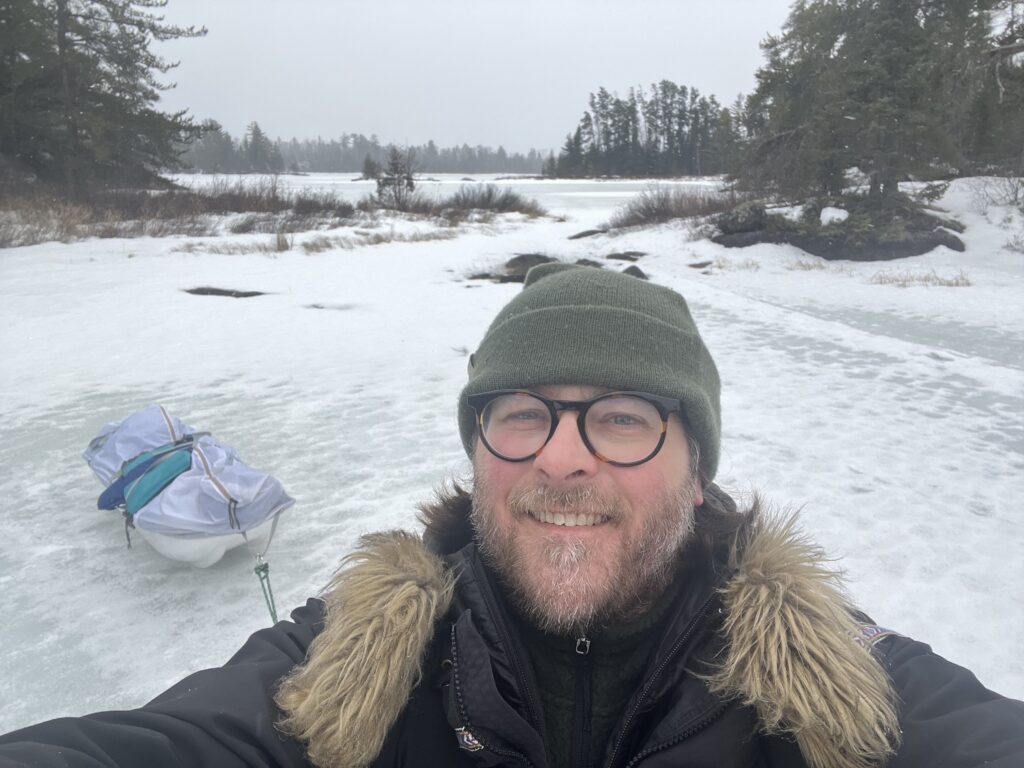
Coming out of the first pinch the ice is hard and fast, but without much of any snow coverage it is slicker than ideal for my trusty Nordic skis. A little bit of snow provides a more consistent kick, especially when pulling a sled. With that said, once up to speed I fly across the ice, thanks in great part to my Redfeather Pulk Sled.
Heckuva Portage Sled!
Redfeather put a lot of time and effort into designing a high-volume pulk sled that doesn’t bog down under its own weight. The runners are made from a special material that cuts down on drag and resists snow clumping on the ski surface. When I am going at a full clip, the sled provides me with great inertia, and the travel becomes shockingly effortless. I’ve pulled plenty of sleds whose weight makes for constant resistance, regardless of conditions, but my Redfeather sled flies!
I make it to the end of the narrows before Lake One opens up. After checking the clock and resting my feet a bit I decided to push on in the direction of the portage separating Lakes One and Two. I’ve made great time and all my options are on the table.
Most of the time in the winter I find that one will make fewer miles (shorter distance) than one plans; conditions can make the pace crawl and the body cramp. I am always diligent about checking my body, my clock, and my pace on winter trail to make sure that I am not putting myself in a difficult or dangerous position. It’s one thing to push hard on day one, but taking the return trip (after less sleep and exhaustion from previous days) into consideration is equally important.
After a short push to the portage, I find good ice conditions below the creek, but the portage is littered with bare patches of rock and earth. The same warm temps that led to fast ice conditions also make the portage impassable for the pulk sled. I am left with a choice between finding camp on Lake One, to prepare for a daytrip into Pagami Lake, or carrying my packs and sled on my back over both portages. The other concern I have is that I will cross the first portage, which will be time-consuming with multiple trips and reloads, only to arrive at open water on the pond separating the two sections of portage. Because the pond is in a boggy area, composting materials under shallow water makes ice conditions less certain. I have gone through ice in the middle of winter while travelling through wetlands before, because the ice melts from below as composting material generates heat. This is another element of winter travel that deserves consideration. So, I decide to turn back and find camp.
Proper Winter Campsite
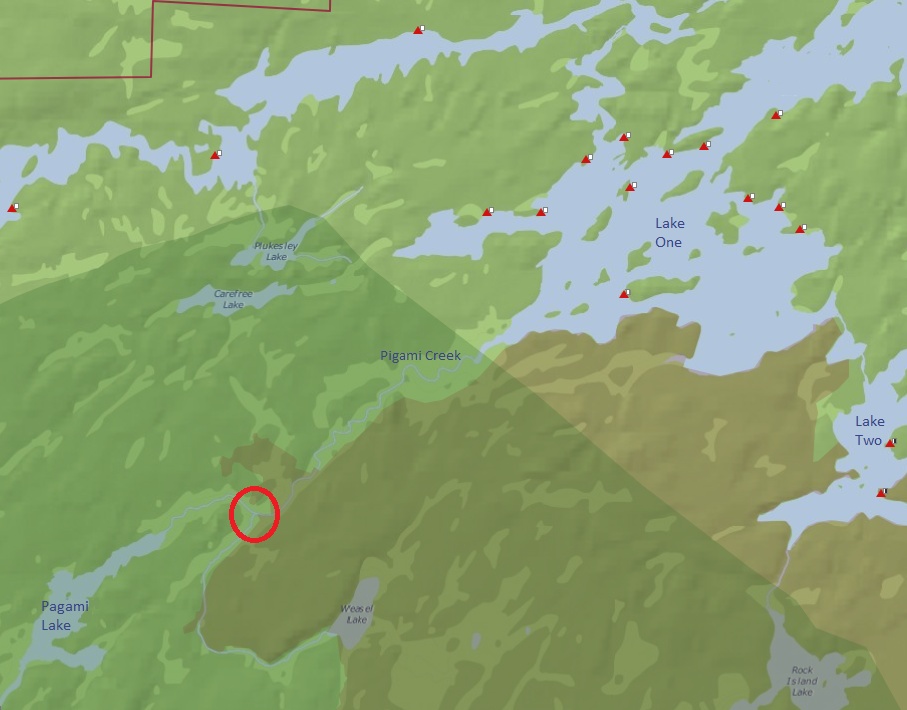
If you look at a map of Lake one (shown at the start), you will see that the portage to Lake Two is at the Southeast corner of the lake, which is a bit of a trek from the campsite I prefer for winter trips. I won’t identify this campsite unless you come say hi to me at the store, but I will lay out some good winter campsite elements for those interested:
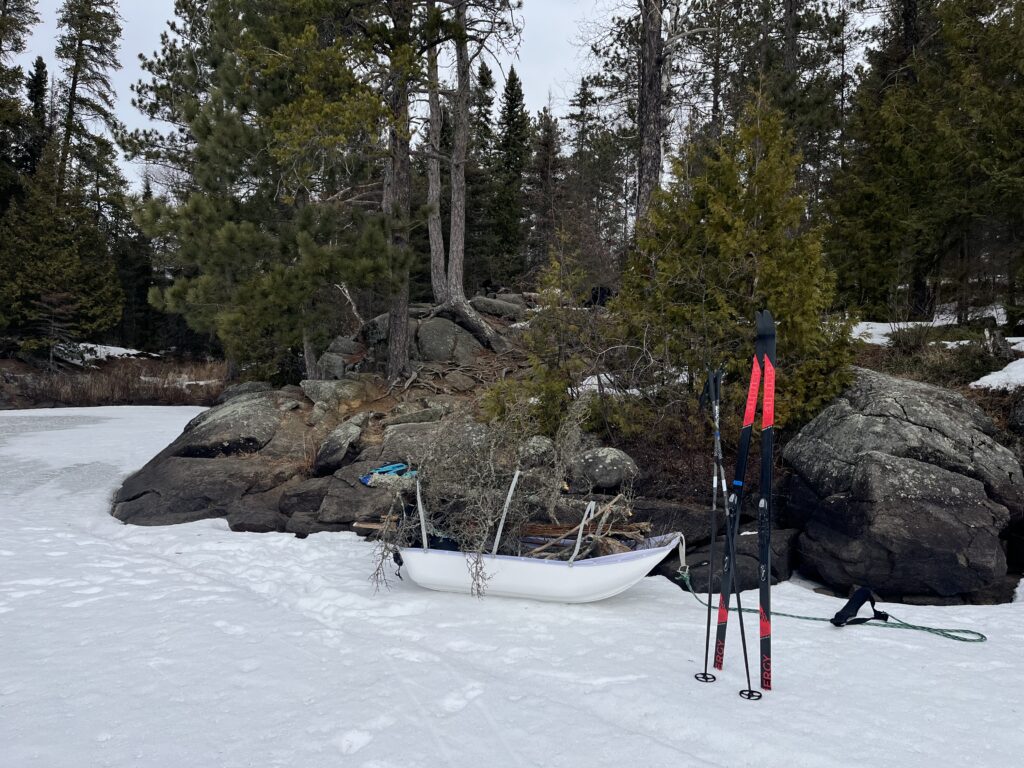
The first thing I look for in a winter campsite is something that provides natural wind block. No matter how hot the coals of your fire might be, it won’t help you if a cold northern clipper is blowing cold air at you. In preparation for a trip, it is important to have an idea of what direction the wind will be coming out of, if the wind will be shifting and when, and to also judge the wind on the day you are making a camp. If the wind is coming out of the Northwest, find something, ideally, on the Northwest shore that is nestled into the woods. If you are camping with a hot tent, this will help you avoid backdraft (smoke in the tent), but even more importantly it will help campers avoid the wind while in camp. Other things to consider are proximity to fishing spots (you won’t want to trek several miles to fish) and proximity to your exit point in case the weather changes or there is an emergency.
Wood Hauling Machine
I arrived at camp around 2 pm and unpacked so that I could use the Redfeather pulk sled for gathering wood. This was my first overnight trip with the Redfeather pulk, so I was excited to see how it would handle a large load of wood. I’m a gearhead, as are most of you reading this, I’m sure, so the prospect of breaking in my newest piece of gear made me giddy. So, I grabbed my Redfeather snowshoes (Alpine Model), my hatchet and my camp saw, and set out. As most of you know, it is best to gather wood away from a campsite – it makes for a fun day trip and you will find way more good wood away from the campsite than in the immediate vicinity.
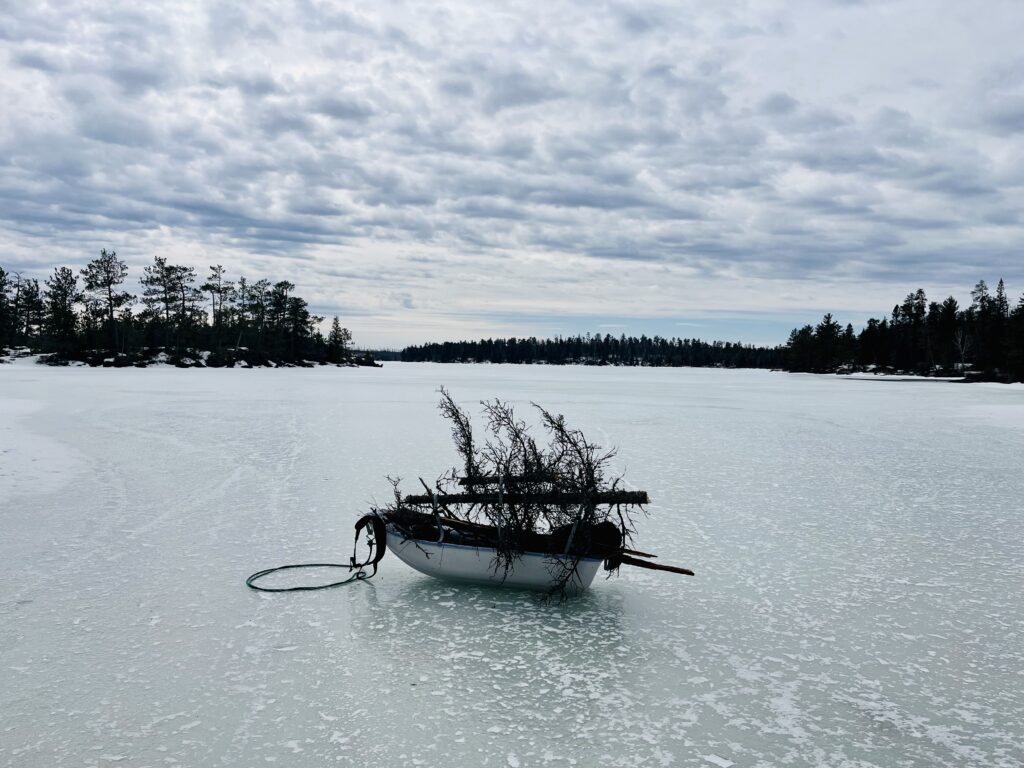
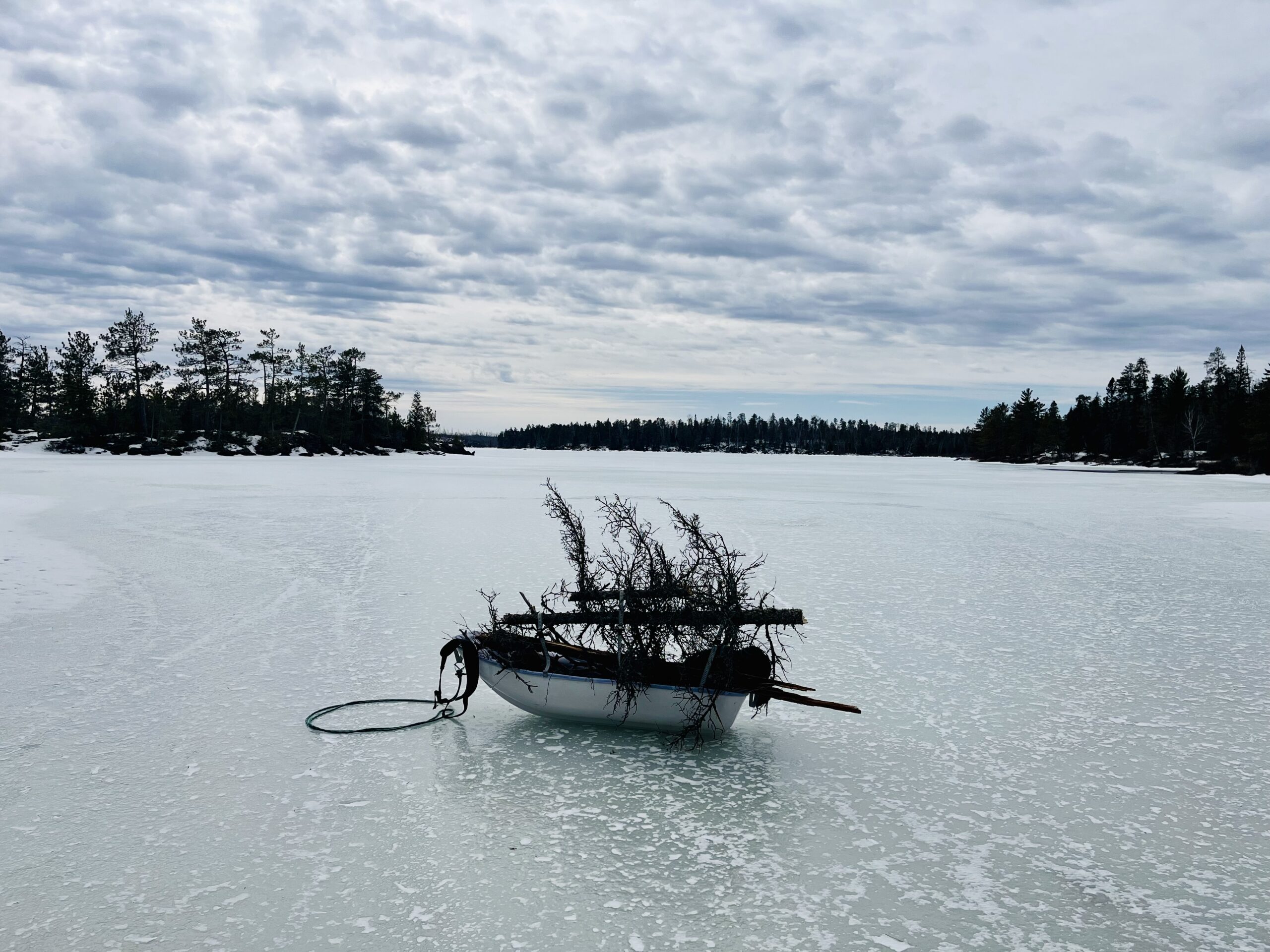
I found some good rotting wood to throw into the bottom of the fire, to generate sustainable coals, and a downed and dried out pine that I cut off straight away as a long pole. I leave the branches attached as much as possible on the longest pole I can fit in my sled so that I can carry more wood. If you process it where you gather it, you then must stack and carry it inside of the sled. It may look comical in the sled, as you’ll see in the photos below, but it is much more space efficient. The straps on the Redfeather pulk are perfect to secure my long poles as well as some other dried logs I find and throw in the sled alongside the rotting trunk I found. I think gathering wood with this sled was my favorite part of the trip, and I left enough wood at camp the next day to make a happy camper out of the one who finds it in the spring.
Get the Fire Ripping
Back in camp I start to process wood so I can get the fire going before I put up my tent. If the weather was worse, I would probably put my tent up and sleep system out before doing anything else, but given the warm temps and sunshine I decide it can wait. Once I’ve worked my magic with the saw and hatchet, I get the fire ripping and decide to put up a wind break. While you don’t often need a tarp on winter trips for rain, they come in handy for blocking wind. There are no campsites on the southern shore of Lake One since the Pagami Creek fire, and despite my efforts to find a shielded site the southern wind has crept through, and a wind break will provide me with relief until the wind dies down. I can’t emphasize enough how easily wind can ruin a winter camping trip, so having a way to manage the wind is crucial. After the wind break is up, I get the rest of camp set-up and sip a bit of whiskey while I make dinner.
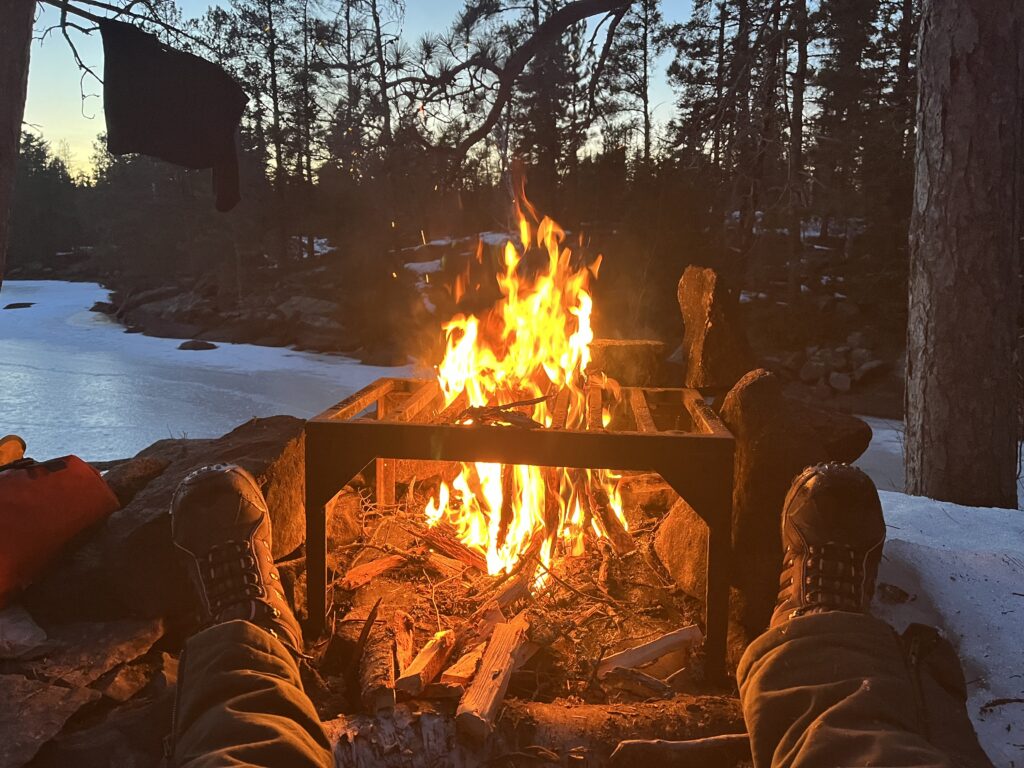
For dinner I eat the homemade curry I packed from home. On trail I like to rely on a mix of homemade meals that reheat nicely with freeze dried backups in case my stay gets extended by bad weather or I need to warm up. An underrated function of hot food is the ability to get the engine going and warm a chilled body up. As important as having an emergency kit with a fire kit and dry, warm clothing to prepare for a potential fall through the ice, it is also important to have a food option that is easy to heat up quickly. There are a lot of techniques people ascribe to in order to recover from a cold water plunge in the wilderness, and it is important that all people develop their own kit through personal testing and research, but if you can get warm food into your belly, it will go a long way to helping the body heat itself up. The hearty chicken curry fills and warms me.
I spend the rest of the evening hiking around the campsite, even taking a quick walk to the rapids that lead to confusion lake, and get another ripper going in camp to enjoy the sunset.
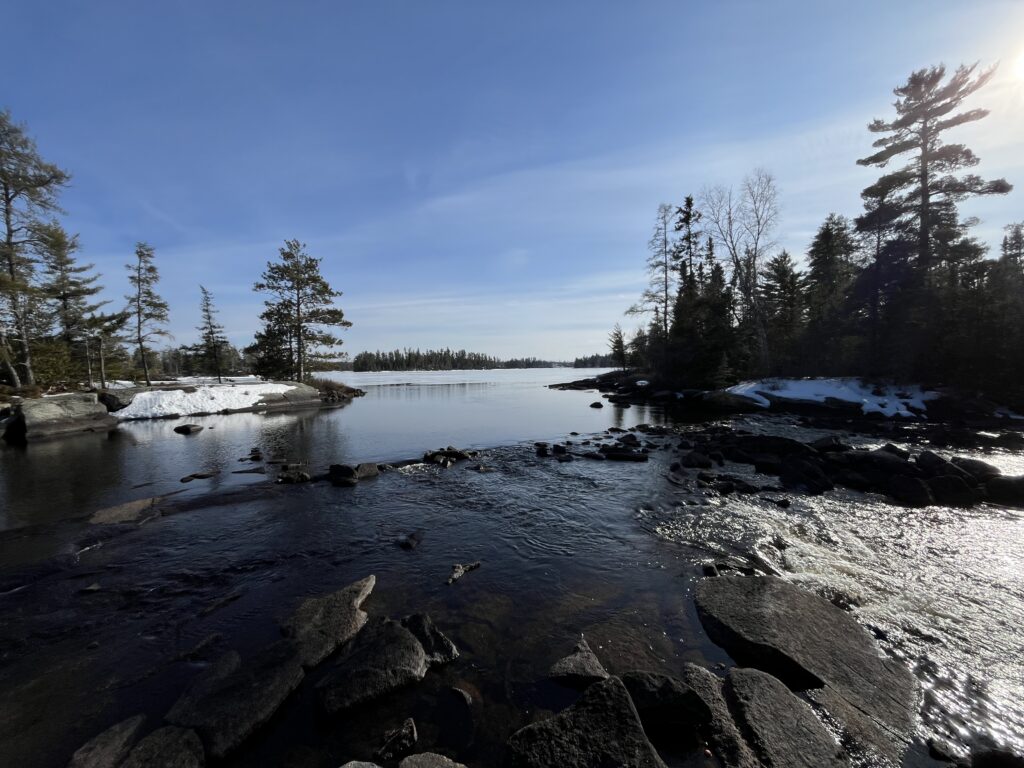
I wake up to the worst inevitability that faces every winter camper: getting out of the sleeping bag. If you have a good sleep system to stand up to the cold of winter, you dread leaving it to get back outside. I like to sleep with my mukluks in the sleeping bag so that I have warm boots to put on in the morning. After sliding the boots on I take care of the morning business and make coffee. I then grab my emergency winter daypack and the supplies I’ll need to travel to Pagami Lake. It is critical to develop your own emergency pack based on your own experience and research, to know your limits and what you are prepared for, but I provide my gear lists to spur ideas for those starting to go down the winter path.
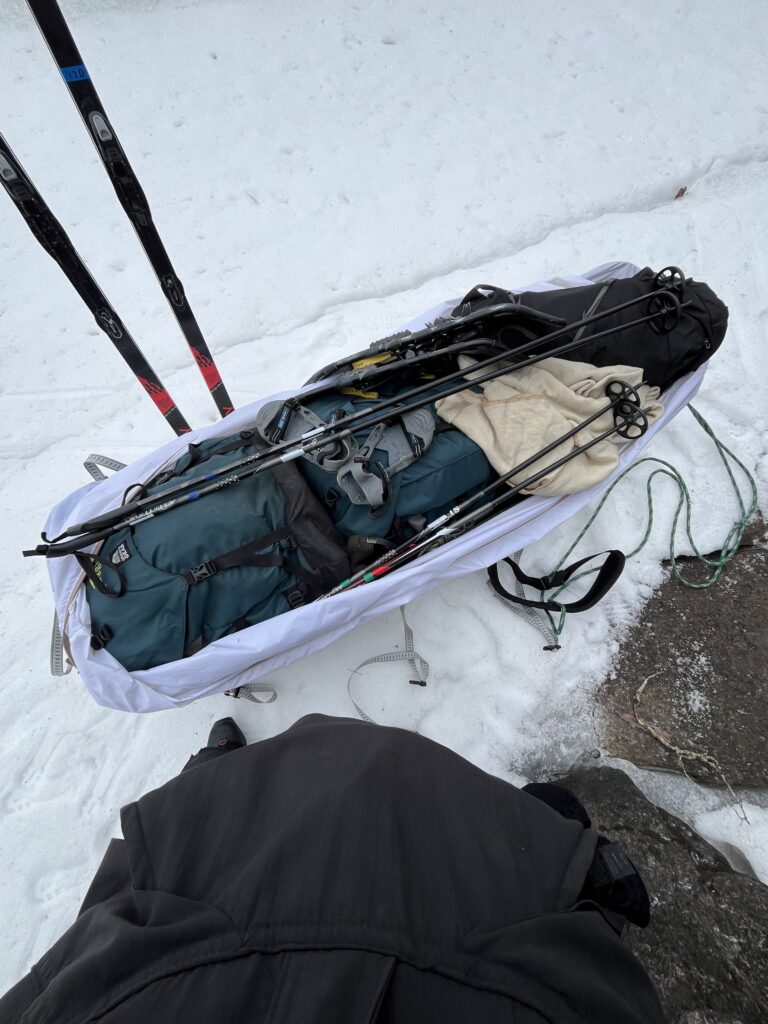
After loading up the sled I decide, given the conditions, to walk across the lake with ice spikes and have my snowshoes handy in the sled, just in case. While the ice was clear and hard, there is still a lot of snow in the woods that might require snowshoes. I also continue to travel with walking sticks, as a means of having traction on the ice, but most importantly so that I have ice picks in case of a fall through the ice.
Ice Songs
The morning is crisp and the ice is popping as I crunch across the lake in my spikes, pulk in tow. After a warm day and cold overnight, the ice machine is not done for the season. Just as we lose ice when daytime temps rise into the 50s, the lake makes more ice overnight when temps drop, and the result is popping ice. It also pops and cracks under my weight as large sheets settle and grind up against others, a reminder that the ice is not an inert, single piece of ice, but rather a shifting patchwork of plates floating on top of soft water. After years of trips across ice, its song can still unnerve me, especially in the spring when my thoughts are fixed on the ever-changing environment.
I reach the mouth of Pagami Creek at about 10 am. I approach the creek on the shoreline, where the water is shallower. The ice does thin on the shore first, on the main lake, but in places where there is potential for moving water, such as the entrance of a creek, I’d rather put a foot through in knee deep water than 15 feet from shore. And just as I mentioned earlier, when discussing the potential for portaging onto Lake Two yesterday, I am also thinking about the effect of composting materials in wetlands, which are synonymous with creeks. After a good deal of investigation, I determine that the ice on the creek is still strong, but I decide to stow my pulk sled near the entrance and continue with only my emergency pack and trekking poles. No matter how confident I am in assessing the ice on the creek, I know there is increased potential for a fall through the ice in this environment, and a pulk sled attached to my waist would only complicate matters.
Spring Ice on Pigami Creek
I continue gingerly down the creek into a beautiful area. Humped hills rise around me as I enter a small canyon. The Pigami Creek fire of 2011 originated on the Southeastern shore of this creek, and so the canyon’s walls are lined by deadheads on one side of the creek, and vibrant, mature trees on the other side. It creates a curious juxtaposition of the destruction necessary to cultivate a healthy ecosystem, one side blackened and ominous, seemingly devoid of life, the other filled by chirping birds and green pines. When I first started visiting the Boundary Waters as a city dwelling youngster, I found a great deal of horror in the burnt sections of forest found at the end of the Gunflint Trail, but I’ve since learned to appreciate its unique beauty, colored by the learned knowledge that fire brings renewal to the land.
Not to be captivated by my thoughts and the surrounding splendor, I continue to follow the creek and pick up some tracks from a Moose who must have happened down the creek no more than a week prior. The temps had been warmer the week ahead of my trip, so his heavy gate left deep tracks, at least three inches deep, in what must have been slush at the time. This kept me on guard against deteriorating ice, as that much slush was emblematic of how fast conditions were changing. It also made clear how much weight had been trudging over this path within the past week.
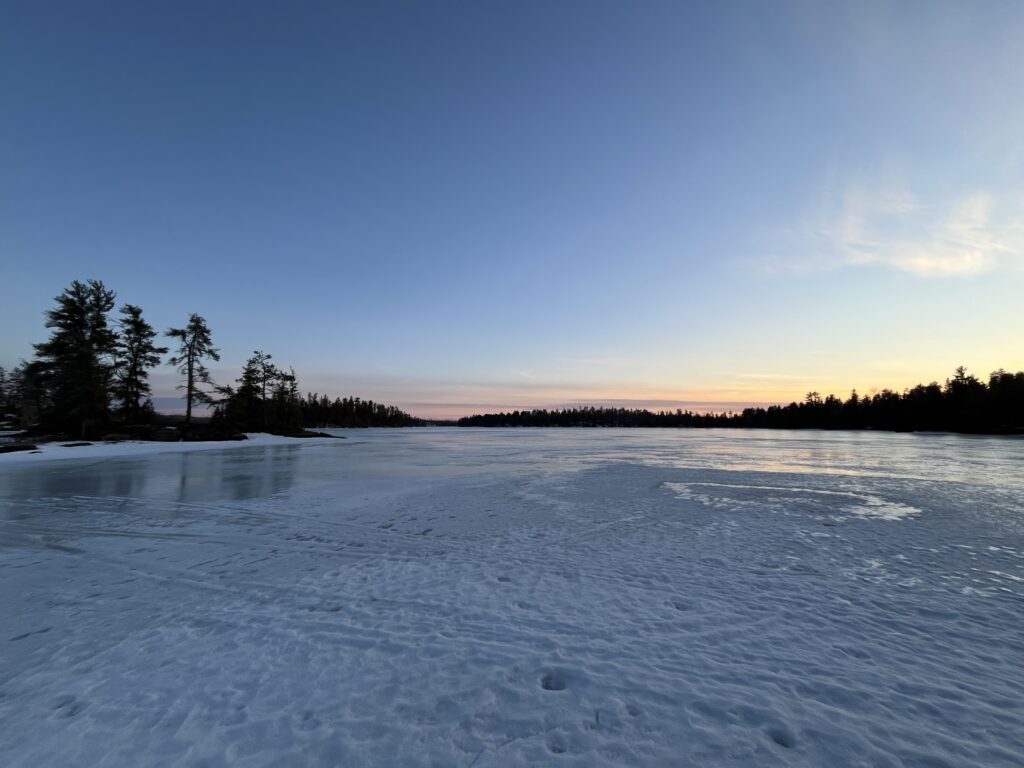
Reaching the halfway point on the creek enroute to Pagami Lake, I started to notice spots where the ice looked weaker than other spots and navigated around, constantly reassessing the ice. When I reached spots that looked suspicious, I would use a trick I’d taught myself during my many daytrips into wetlands (wetlands are my favorite place to snowshoe): when the creek you travel on looks thin, stick to the grassy clumps at its edges, where the potential for deep water is lower. As I am to discover, this is a double-edged sword. The ice is more varied in these places, weather it is because the composting effect is greater as the water depth decreases, or because the grasses impact the melt of ice, I can’t be certain, but the middle of the creek, where the water is deeper, has more consistent ice when the flow of the river is not varied. Even as I write this, I cringe, because there are so many factors impacting ice conditions in this environment. The bend of the river can speed up water and create thin ice on one side, a shallow hump around a rock can create thin ice, and a myriad of other factors. So, my advice is that you never trust ice in a wetland and always be prepared for surprises.
Don’t Trust the Ice
Approximately a mile and a half form the mouth of the creek I reached a confluence of creeks (the red circle on the map posted at the start of this article) that meet in an area where the canyon opens up into a larger wetland. I also started to encounter some open water. At this point I would have been well advised to turn back. But the heart of an adventurer is always attracted to the challenge of finding a path through. At first, I started to follow grass clumps southeast of the creek and reached a point where I’d be forced so far around that I would be using too much energy. I retraced my steps and headed for the Northwest side of the creek, again following clumps of grass to work my way around the open water.
Falling through ice is a funny thing. I’ve gone ankle, knee, thigh deep through ice multiple times in swamps and creeks, and it all starts the same. The ice gives way, slowly at first, then all at once you are falling through an indeterminate distance down. Even after one has completed his journey through the ice itself, in a wetland the bottom is not determined by the point where one hits ground – there is no bottom to a swamp, not in the way a swimmer feels earth between his toes near shore. The speed of decent, which picked up pace after the ice had fully given way, again slows, as does the movement of the limbs that are becoming ensconced in mud. The first two times I put a foot through ice in a wetland my body’s initial reaction led to a flailing of the limbs, a panicked effort to find a handhold that didn’t exist. Once on a creek between Found Lake and Monomin Lake, just west of Moose Lake (a path only passable, without massive struggle, in the winter) I fell forward after putting a foot through the ice. A fall forward, back, or to the side, unless the side is a solid shoreline, is to be avoided at all costs to limit soaking the entire body. I’ve since come to the conclusion that trying to stay upright through the fall is the best intention one can have as his adrenaline spikes and the survival mechanism ramps up. Don’t panic, stay upright.
Here I was, a mile and a half from my sled, 3 miles from my camp. With one foot over a clump of grass came that oh so unnerving feeling of weightlessness followed by a decent into nightmarish uncertainty. It’s moments like these that I wake up to in my bed at home finding a handhold in my bedsheets that does not exist below the ice. I vaguely recall entering the water, and I barely recall turning (one should always turn back to where one was travelling from to get out of the hole he’s made in the ice) and effectively launching myself back up and onto the ice. How strange it is to find oneself transported back onto solid ice, soaking wet up to his belly button, mud midway up the shins, with no sense of being cold and little recollection of what led him there. From the time I felt the ice give way until the time I was out of the hole was a blur, my instincts and experience had taken over and delivered me. In great part my life is about exploring the wilderness, and I’ve played scenarios through in my head, ad-nauseum, for years. The same obsession with safety that seems overkill to some, along with a lot of experience in the woods, had prepared me for the worst. And so, I stood, though not for long, back on solid ice.
Know Your Kit, Test Your Kit
I quickly retraced my steps, moving fast but also mindful again of ice conditions, back to my sled. Because my base layers are all wool, I did not stop to change. The adrenaline certainly played its role, but the wool and my movement kept me fairly warm as I worked my way back to the mouth of Pigami Creek, hyper focused and thinking clearly. I reached my sled quickly and then took the time to shed my wet outer layers (leaving the wet wool on to dry with me) and threw on my emergency puffer coat and dry pants. Within half a mile of travelling back across the lake I was beginning to properly warm back up and decided to gather some wood to further assist my body in warming up. If temperature had been colder or conditions different, I may have opted to head for camp and hit the sleeping bag for a hot freeze dried meal heated in the Jetboil, but at this point I was no colder than if I’d been sweating in the hills above the North Arm of Burntside on one of my regular ski trips.
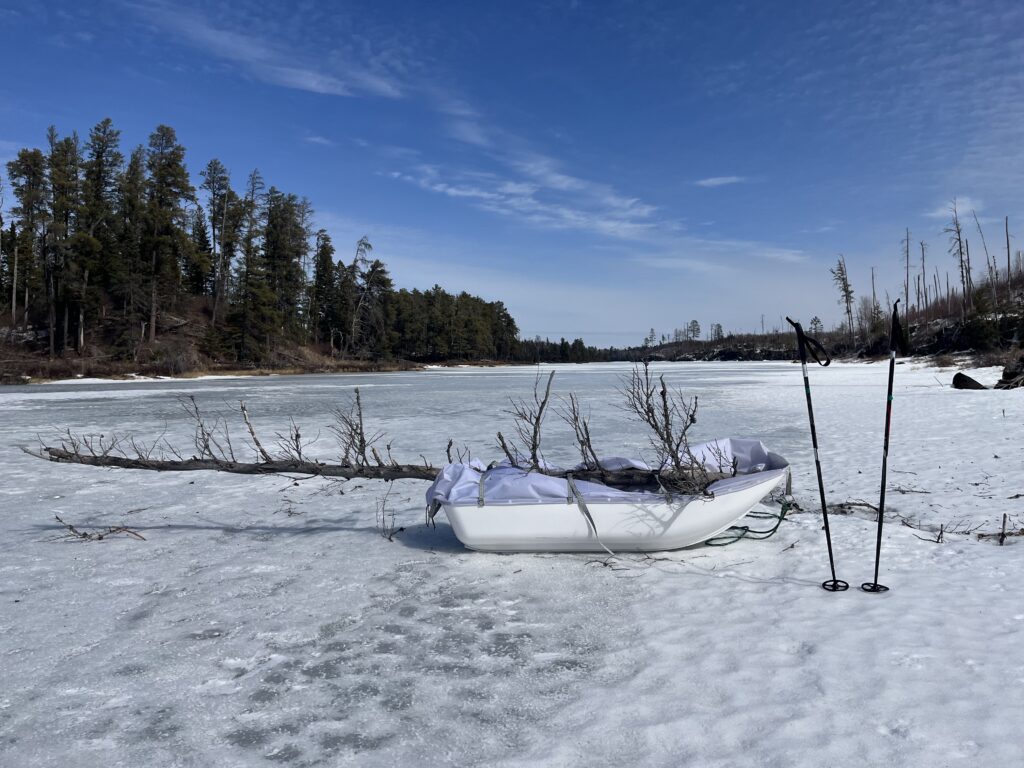
Again, I filled the sled with wood and made my way back to camp. In camp I changed socks but kept my base layers on, which were close to dry within an hour. Other than the horror of replaying the situation in my head infinitum, I was left no worse the wear, as if nothing had happened. It’s funny, but there was a certain sense of security in having tested my survival skills, my emergency kit, and my base layers to such a degree and come out unscathed. So much of adventuring into the wilderness is about learning through experience and being back in camp I had a sense of confidence that my preparation and experience had paid off. I also found another boundary for what is safe and unsafe, to inform future travel. It was not the first time I’ve encountered such a boundary, and it won’t be the last. I only hope that my learning will continue to keep me safe.
Fireside Relief
The rest of the day I relaxed, hiked around the area a bit, and enjoyed the company of the campfire, trying my best not to get carried away by my obsessive thoughts surrounding what had played out on Pagami Creek. An early night found me asleep quickly after I crawled into my sleeping bag.
I woke up in the morning, made coffee and quickly broke down camp. After packing the sled up, I skied out and was back home in Ely before noon. Not all adventures go as planned, but I will mark it down as a successful trip. Find my packing list below to see how my kit compares to yours. Just remember, your kit is your own and you should never rely entirely on someone’s recommendation when travelling in the wilderness. What works for me may not work for you.
Thanks for reading.
Tyler
About the Author
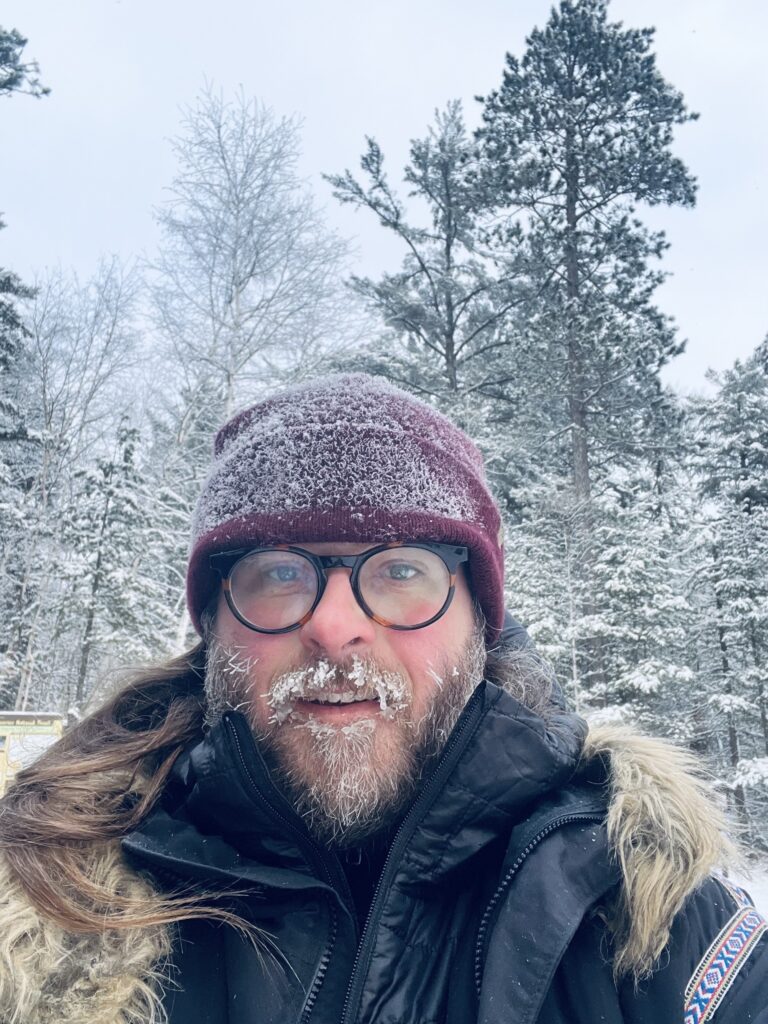
Tyler is the store manager at Redfeather Outdoors in Ely. He moved to Ely in 2020 and has been exploring the surrounding wilderness with his wife and kids ever since. He is an avid canoe paddler, nordic skier, and hiker. He maintained a rental fleet of over 200 canoes at a prominent canoe outfitter in Ely for 5 years before signing on to help Redfeather Outdoors open its first retail store. His knowledge of the Boundary Waters Canoe Area Wilderness and Quetico Provincial Park is extensive. When he is not in the shop at Redfeather he is either out in the woods, paddling a canoe, or coaching his son’s baseball team. Visit the store anytime and say hi to Tyler. He loves nothing more than a good canoe story and will offer anyone tips on a good daytrip or how to fix your canoe,
About Redfeather
Redfeather Outdoors has built its reputation around gear shaped by real time outdoors, with a strong emphasis on durability and performance in the conditions people actually face. Our canoes and snowshoes are handcrafted at our facility in La Crosse, Wisconsin, reinforcing a commitment to American craftsmanship and consistent quality. That hands-on approach shows up in the details, giving paddlers and winter explorers confidence as they head into the Boundary Waters and beyond. To explore our full lineup and learn more, visit https://redfeatheroutdoors.com/
That same mindset carries into our flagship store in Ely, Minnesota, a location that fits naturally with the brand’s connection to the outdoors. The Ely store serves as a hub for trip preparation and practical guidance, offering insight shaped by experience along with access to gear built for northern Minnesota conditions. It’s a place where visitors can get ready and head out with equipment they trust.