
I was locked into an expressionless trance where my entire being focused on the task at hand, locked into the flow of the river, the obstacles around us, every flick of the paddle through the water and every shift and shudder of the canoe as it was pulled and pushed by the torrent, threatening to dump us over falls, or the shifting current below rapids slapping at the zero-rockered hull of our canoe – these slaps felt like a hand under the surface of the water grabbing the stern to throw it sideways and then back. The most exhausted I was on the entire trip occurred after this section, not from the physical exertion, but from a series of adrenaline dumps and the necessity of peak focus held for four hours straight. Once we reached the portage around Twin Falls, the final falls emptying into Lac La Croix, my nerves were shot and I was completely drained of energy.
When I moved up to Ely and started hanging out with serious paddlers, I heard about a “race” called Hunter’s Island, a 150 mile loop through many of the great sections of the Quetico and BWCA wilderness areas. The route follows the two major flowage routes of water moving away from Saganaga Lake to Lac La Croix, one north through Quetico park and one south along the border between the U.S. and Canada. In discussing the route with friends, it became clear that Hunter’s Island is the local testing ground for paddlers, where one can prove himself worthy in an outstanding challenge of grit and see where he stacks up against the rest (time is an element
of the race). It wasn’t long before I dedicated myself to preparing for a sincere attempt.
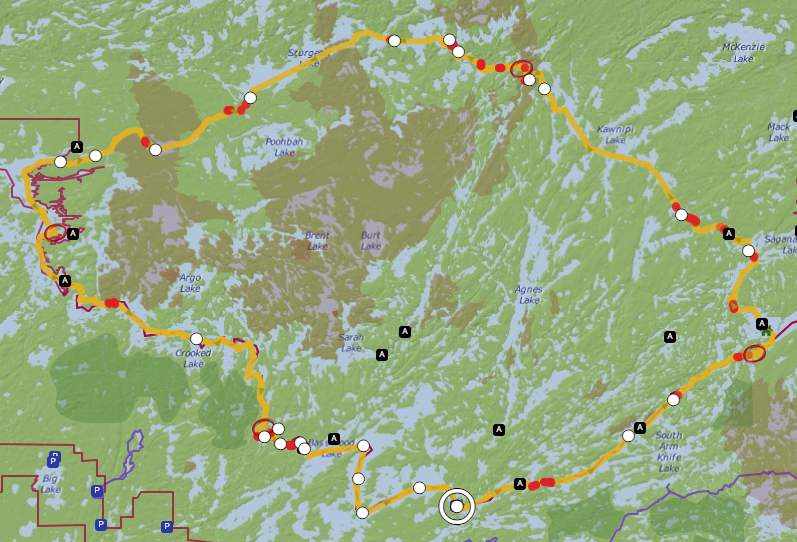
Late last year I reached out to one of the guys I have done a marathon paddle with, Zachary Sunne (I completed my first 50 miles in 24 hours paddle with Zach last summer). Zach is a thru hiker who has completed some serious hiking trails (3,000+ mile Central Divide Trail, among others), and an unflappable paddler. Zach was unsure if he was going to spend another summer in Ely, exploring the wilderness for a third year before starting a more permanent life elsewhere, but I aimed to entice him back with the prospect of a go at Hunter’s Island. What impact this had on his staying for another summer I don’t know, but he obliged to be my bow paddler.
Dreams of High Water
In my dreams and contemplations about the race, there was no shortage of misgivings about the route and some of the unknown perils: would we be able to average 30 miles a day for 5 days regardless of conditions (we both had 5 days off of work); would wind blow us off the big lakes, obliterating our pace and determination; would the Maligne River, dangerous in average conditions, be overwhelming with rapids and portage entries just above waterfalls; could my body handle the seven miles of portage trail on top of long hours in the canoe. These
and other concerns weighed heavily on my mind before taking a single paddle stroke, before nature upped its ante.
Leading up to our trip date, conditions were already high, high enough for the Ontario Parks service to issue an alert stating that all travelers should re-route around the Maligne River (a necessary portion of the Hunter’s Island route), as high water made the river exceedingly dangerous to navigate. This is a section of the Malign that authorities advise novices and groups with children to avoid in normal conditions. I spoke to a fellow paddler in the area who had been on the river a week prior to our departure, and he assured me that while conditions were
extreme, the river was not impossible or inherently dangerous for an experienced paddler. I steeled myself and decided we’d move forward with the plan.
Historic Rain On Top of High Water
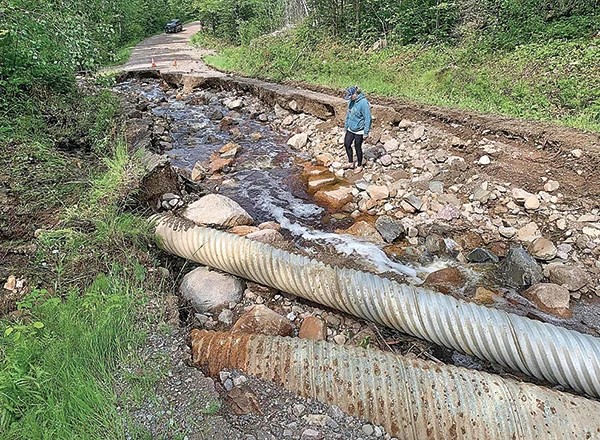
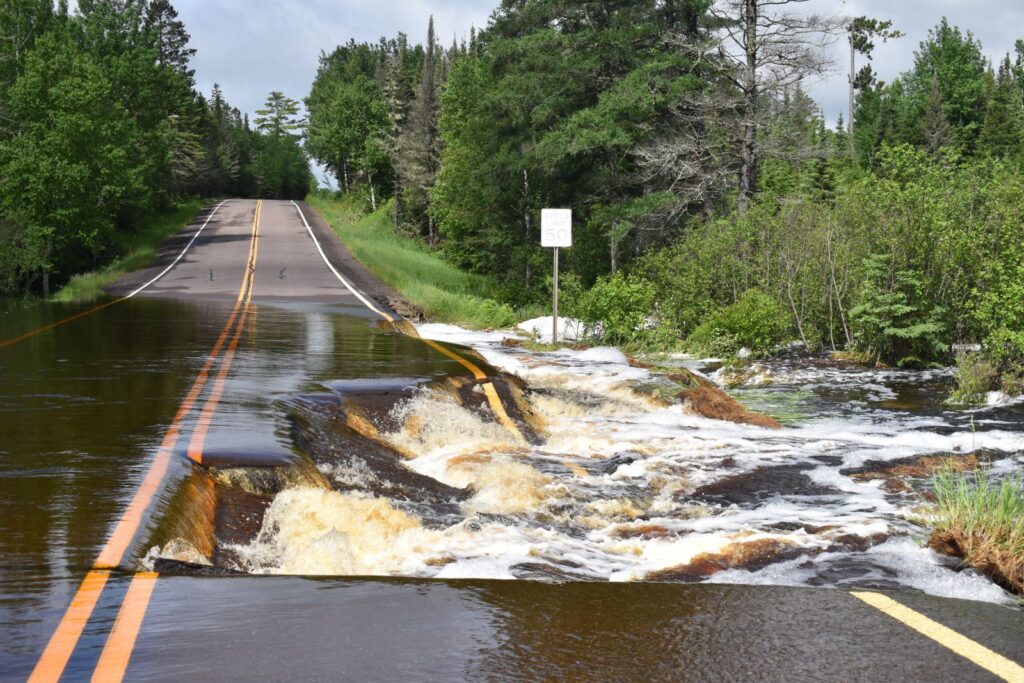
Then, on the first day of our trip, only 21 miles into the route, the skies opened while we were portaging between Swamp Lake and Saganaga Lake, dropping between four and seven inches of rain in one night. We were forced to brave the tempest only long enough to find camp, marooned well short of our daily goal (we’d planned to paddle overnight across Sag to the northern end of Cache Bay), putting us well behind our average pace to start the trip. Zach and I had no way to know how much rain was falling that night but it was enough to wash away roads leading to the north arm of Burntside Lake as well as the Mudro entry point, trapping BWCA travelers and, more importantly for our trip, super-charge the Maligne River and Falls Chain of lakes.
As I laid in camp that first night I obsessed over the prospect of a bloated river and the possibility of getting caught downstream at a point where we could neither continue our route for fear of capsizing above a deadly falls, nor turn back to fight an impossible current upstream. A couple of weeks before our departure I had helped a man, Erik Grams, whose brother, Reis Grams, had perished when they were swept over Curtain Falls – Curtain Falls was on our route – with advice on how to repair the heavily damaged canoe that was carried over the falls. The danger was not abstract in my mind, it was palpable and gripped me with a fear that was physically visceral. Even now, writing about my experience, I feel a pit growing in my stomach, the carnal instinct clawing to escape my past terror. Zach and I discussed our situation and decided to push forward and see how the falls chain looked before making a decision. I’ve posted a video below that shows how the falls were pumping. The video does not show the most impressive water fall, but I think it demonstrates how fast the water was moving.
Deformed Terrain
When we arrived at the start of the falls chain, a beautiful stretch of the park north of Saganagons, the river was bloated. In my experience with flood conditions, some of the signs of high water are not apparent because the water rises above all terrain, gulping up boulders and leaving no sign of white water approaching rapids, but the deformed flow and pace, undulating in the most unnatural way, is immediately terrifying to observe. The river was one mass of water sucking through the start of the canyon into the falls chain, and a risky approach to the high water portage entrance (many river portages have two entrances, one for high water, one for low water conditions) was a clear indication of extreme conditions. We were forced to skirt around a point before the approach where I felt the stern of the canoe being pulled downstream, much closer to the suction of the falls than I was comfortable with. With a little resolve we pushed forward.
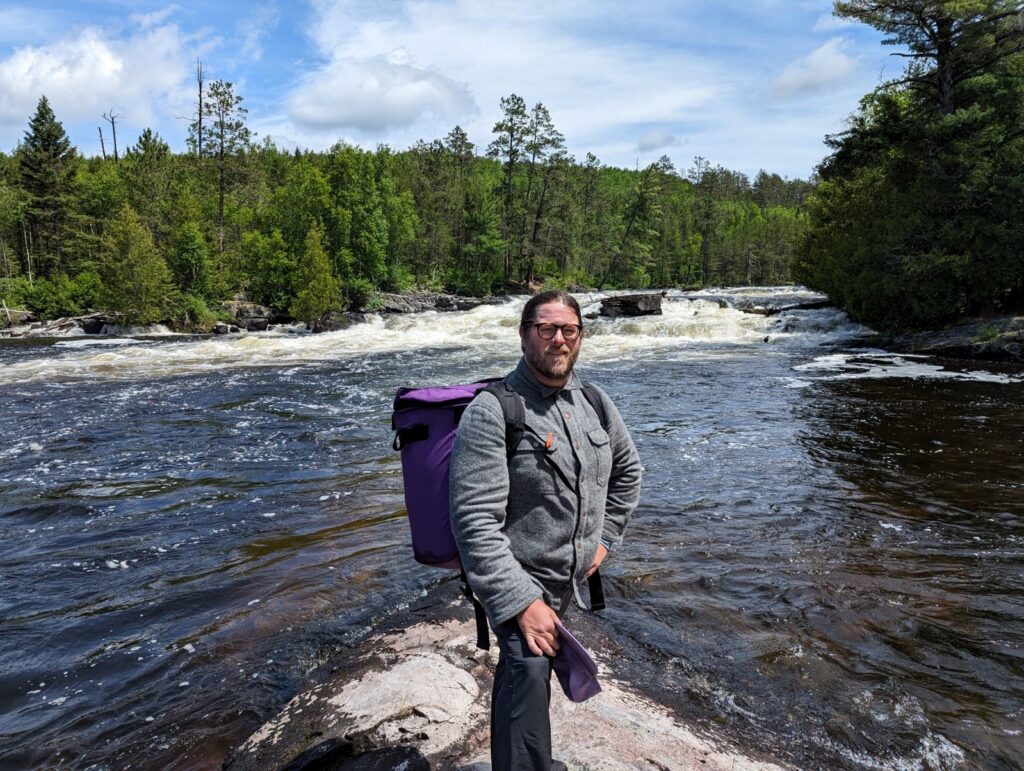
The portages on the entire Falls Chain of lakes and river were rugged with tricky approaches like the first – not a single lazy approach, every paddle stroke was calculated and anticipated. Given the water levels there were mini-rapids running down some of the portages, forcing Zach (Zach portaged the canoe, in addition to the lighter – 50 lbs. versus 80 lbs. – of our two packs, for 70% of the portages, while I took the heavy pack) to hand the canoe to me across sections of the flooded trail. We work well as a team and were able to single-portage without much delay, though it was a grueling slog.
Respite, O Cherished Relief
Zach and I stopped at the first site on Kawnipi Lake after departing the falls chain, greeted by an old Bell Northwind canoe that had been torn to shreds in the falls chain and discarded at the site below – a testament to the destructive capacity of water flowing from one massive body of water into another. I recall thinking at the time how, given the conditions, a Bell Northwind (the same hull as the more modern Redfeather Northwind, available at our store Click Here For More Information) would make navigation in strong currents much easier than what we were experiencing with the race style hull of our canoe.
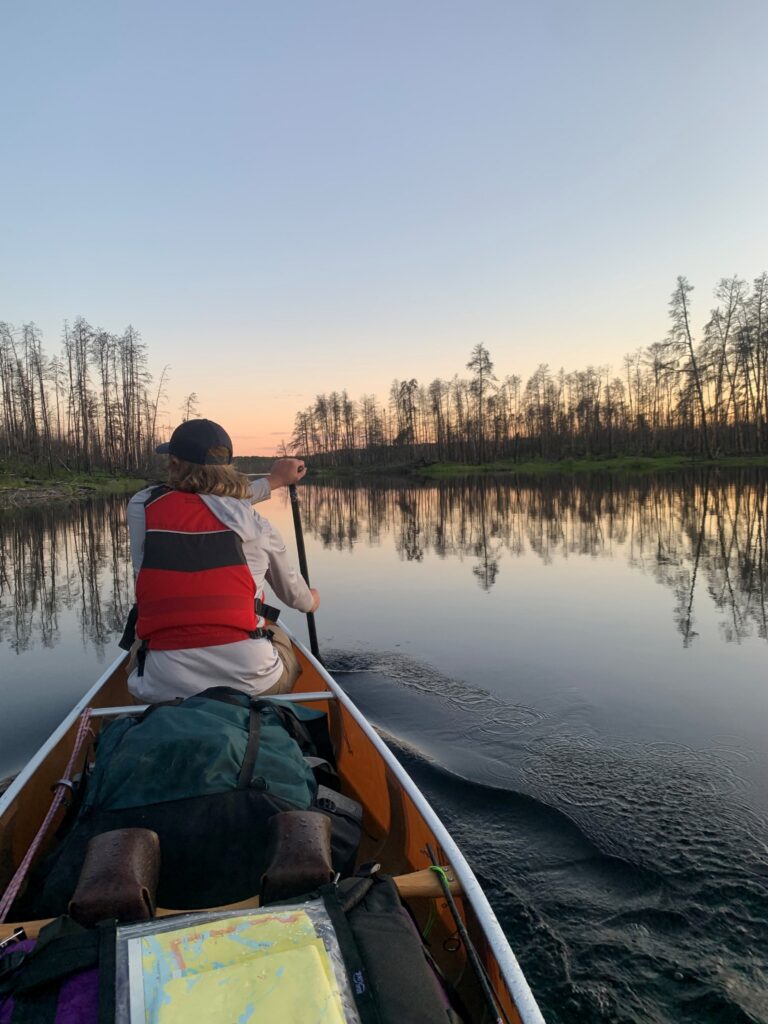
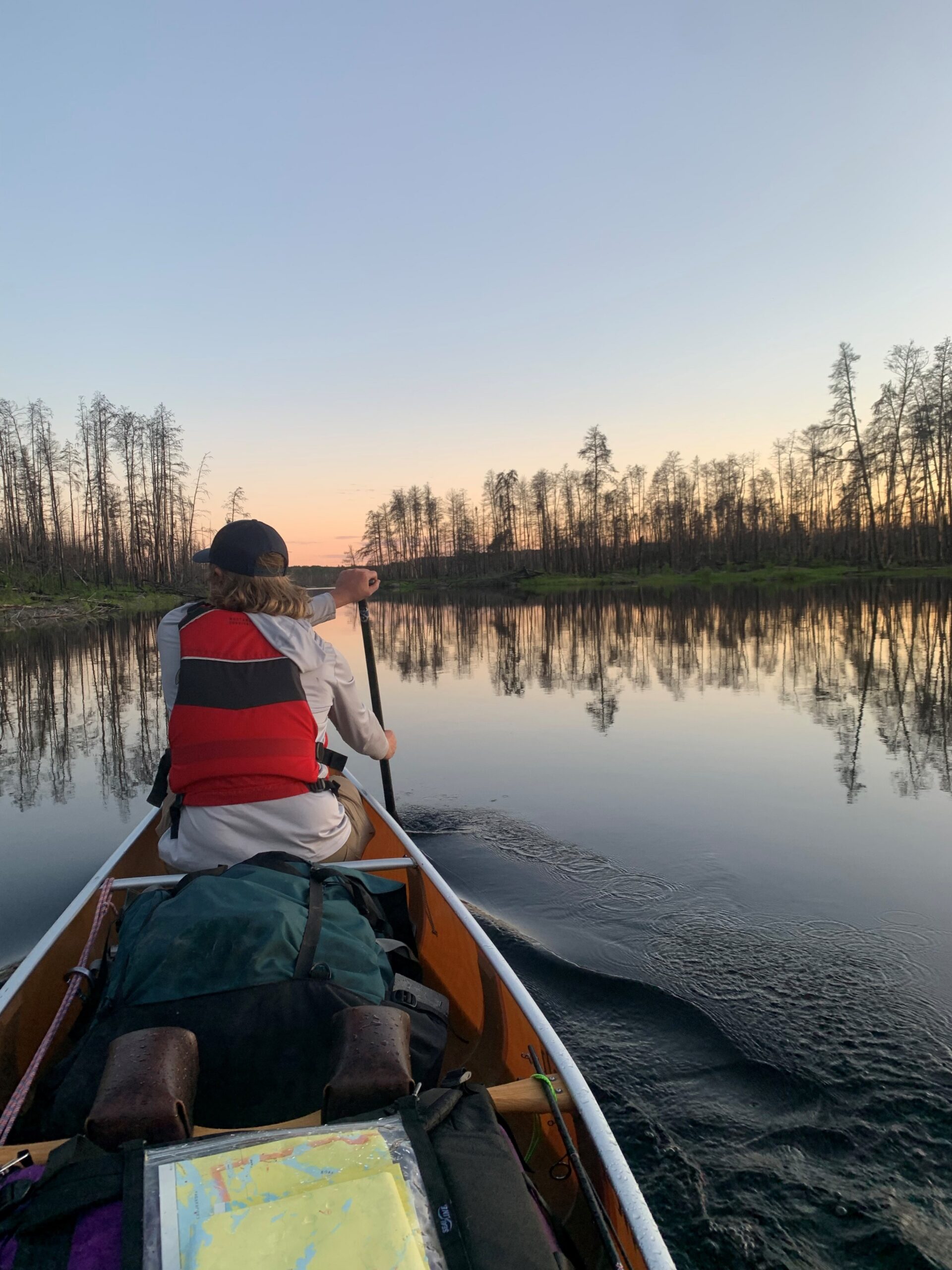
We stayed at the campsite for 2 hours. Most of the time I laid prone on top of cedar pine needles trying to give my hip flexors and tight glute muscles some relief. The sweet warmth of sun and inaction was the sweetest contrast to the strain of constant focus left back in the Falls Chain, and our paddle down Kawnipi would be among the most pleasant of my lifetime. The wind came down for us and we finished our day’s paddle gliding over glassy water through the freshly burned western edge of Kawnipi bathed in twilight (pictured below). Our day’s peril was not complete, though, again having to maneuver around high moving water, elusive in the low light. We were forced to portage through a game of pickup sticks comprised of massive fallen pine trees, a great place to break a leg, where Kawnipi empties into the Kashapiwi Creek. To close the day (it was dark) we ran some rapids onto Shelley Lake in the dark, where we set up camp for a few hours on an island. Sleep came easy but did not last long.
Poetry Precedes Pandemonium
At sunrise on day three we hit the water and paddled through the Poet’s Chain, another legendary region of Quetico, and even shared one of Zach’s hand rolled cigarettes at the end of “Have a Smoke” portage. Keats was my favorite lake in the Poet’s chain for its wide falls, which cascaded into a lake that held the current for nearly its entire length. We took the most strenuous portage of the trip to go from Russell Lake, gaining and losing serious elevation, to Sturgeon. This portage included a direct decent where one would expect to find switchbacks to alleviate the sharp angle of decline, where running water carved a chute into the muddy path. Zach was carrying the canoe and, to be quite honest, I’m not sure how he managed the descent with it on his shoulders.
The paddle across Sturgeon was nice, with low winds at our back. The trees surrounding a large portion of the lake on the Northeastern end were dead, killed by a recent round of fires in the area, but unlike the burned portion at the western end of Kawnipi, these trees held onto all their needles and simply looked sickly. I’m still not certain why these trees died without burning. We took a short break on “Vidmar’s Point” (pictured below) at the southern end of the lake, a sand spit lined by tall red pines that is slowly moving from one end of the lake to the other as winds push sand up one side and erodes the shore on the other – this might be my favorite campsite in all the Boundary Waters or Quetico. My dear friend Thomas Vidmar told me I had to stop there on my trip, and I was happy to oblige. I again laid prone for thirty minutes to rest among the pines – no better place for a nap than a sandy bit of land under red pines. As Viddy would say, “That’s a five out of five stars campsite, Daddy.”

It Never Leaves You
We reached the mouth of the Maligne at around 4:30 pm and the pit in my stomach grew – the river was moving fast shore to shore, from the mouth to the first waterfall. Clearly the river was cresting following the heavy rain and we were approaching it at its most dangerous. Our plan was to portage twice and then decide if we could continue down the river, per some advice from the legendary paddler Adam Macht. The approaches to the first two falls were mild, as each had a bay preceding the approach that slowed the suction at the mouth of each falls, but it became apparent to me that the current was too strong on the river for us to be able to back out, and so our decision was made for us: we would have to navigate the Maligne River in flood conditions.
We spend the next 4 hours paddling down rocket booster rapids, lined by boulders hiding beneath the surface, threatening to tear a hole in our canoe or overturn us, lining our canoes down shorelines where water rushed around our legs, inches from drop-offs that would certainly shroud us in currents that we may never return from, approaching high water portages along suction points inches above waterfalls, bushwhacking through thick woods to get around points where the current was overwhelming, and lifting the canoe over trees that had fallen during the storm and blocked the navigable shoreline of the river while wearing our heavy packs and dealing with the worst bugs on the trip (there were three inch long bugs I’ve never seen before –
super sized may flies?). The water was a cauldron, and like the witch, nature cared nothing for us as the water boiled under us. It sounds trite but it is true: that time on the Maligne was hell on earth.
I was locked into an expressionless trance where my entire being focused on the task at hand, locked into the flow of the river, the obstacles around us, every flick of the paddle through the water and every shift and shudder of the canoe as it was pulled and pushed by the torrent, threatening to dump us over falls, or the shifting current below rapids slapping at the zero-rockered hull of our canoe – these slaps felt like a hand under the surface of the water grabbing the stern to throw it sideways and then back. The most exhausted I was on the entire trip
occurred after this section, not from the physical exertion, but from a series of adrenaline dumps and the necessity of peak focus held for four hours straight. Once we reached the portage around Twin Falls, the final falls emptying into Lac La Croix, my nerves were shot and I was completely drained of energy. I’m certain those hours on the Malign will never leave me.
Paddling Evening Glass
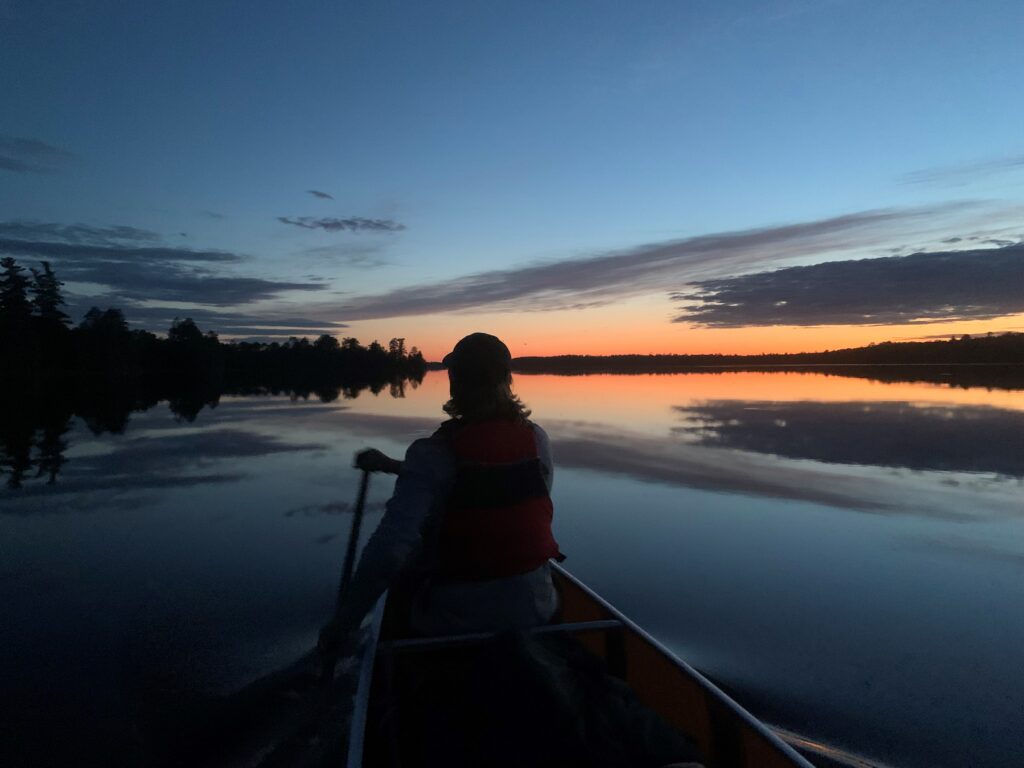
The sun set on us as we reached Twin Falls for an hour-long break before navigating the final rapids through a pinch point to Lac La Croix. We followed rising bubbles of flood waters all the way out into the main lake. I’ve never encountered these rising bubbles before, but I will not forget how ominous they were, the only indication of heavy water flow below the canoe when we were in calmer areas between rapids or falls, hence the witch’s cauldron. I’m not sure what causes the bubbles, but we encountered them throughout the Poet’s Chain on down through the Malign. I again laid prone for the entire break and found a second wind. We paddled for a few hours into the night, marking our location by the shadows of points and islands. There is something magic, albeit unnerving, about navigating a gigantic body of water in the dark – one can see the major landforms and judge his position accordingly, constantly taking stock of the shoreline, lest he loses track and paddles miles out of the way. At 1:30 am we pulled into camp on the southern shore of Coleman Island, and I fell asleep without eating.
Capsizing Below Wheelbarrow Falls
The rest of the trip was calm in comparison to what we had faced during the past two days on the Falls Chain and the Maligne River, but challenging by normal standards. The strong current on portions of Crooked Lake were totally unexpected – areas where on previous visits there was nothing but flat, still water, were suddenly transformed into swiftly currented suction points as water pressed the issue flowing from Saganaga Lake back into Lac La Croix through the southern route. Now heading back east the current was working against us, running in the same direction as the alternative northern route whose current we had paddled with through Quetico. There were times where Zach and I had to work hard to paddle upstream against these currents where it seems impossible that there would be enough water to create current in such deep sections of lake, and it continued through much of the narrows at the southern end of Crooked Lake. Curtain Falls was magnificent in flood conditions, and I was glad to be past it while standing above its entrance. We overturned below Wheelbarrow Falls after choosing the wrong path and were tossed about in the rapids below. Thirty minutes of bailing water out of the canoe on a pile of rocks in the middle of the rapids had us back on track in no time.

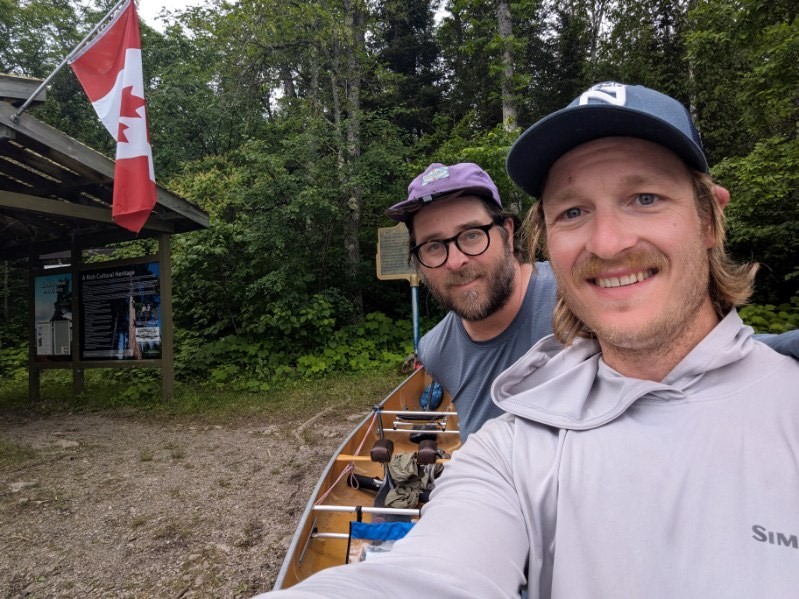
The wind kicked our butts on Basswood, especially after we rounded U.S. point where 15-20 mph winds had us surfing large rollers for several miles. Surfing an 18’6″ canoe with zero rocker is an uncomfortable feeling in a canoe for those not accustomed to the whipping motion a canoe experiences when a large wave carries it with a quartering tail wind. In the stern I had a blast surfing these waves, but Zach was at the mercy of the wave and my draw strokes. More than once he made it clear that he was having much less fun than I was. Turning East for the final time we battled headwinds on big water crossings, cursing the conditions on that final test. At 5:10 pm we beached at Prairie Portage and ran across the portage to complete our loop, four days, eight hours, and forty-eight seconds after setting off. We still had to paddle down Newfound and Moose Lakes, but we were happy to have completed our objective.
Delayed Realizations
It was not until we arrived at the house of our friend James Ehlers that we came face to face with how extreme the conditions had been during out trip. He showed us photos of roads washed out and destroyed by the same flood waters we had careened down on the Maligne, portaged around on the Falls Chain, battled against on Crooked Lake. 4.5 inches fell that first night of our trip in Ely, and closer to 7 inches in the western portion of our route. Many of our friends, especially the serious paddlers who know what high water means, had been hoping we would reroute and not brave the Maligne River, concerned for our safety, and they were flooding us
with text messages. The refrain of our trip is that we were never in imminent danger, but we were never far from it.

About the Author
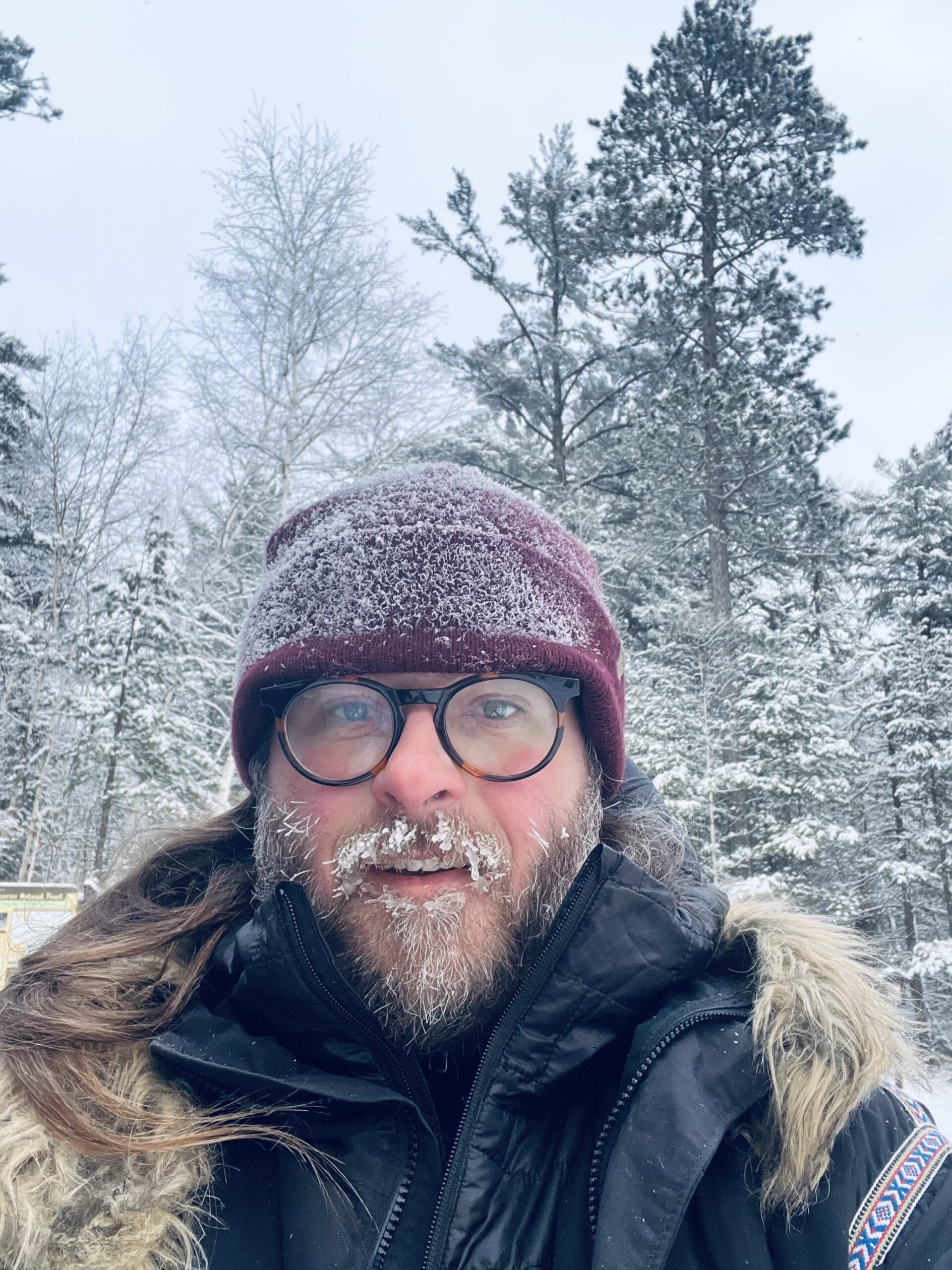
Tyler is the store manager at Redfeather Outdoors in Ely. He moved to Ely in 2020 and has been exploring the surrounding wilderness with his wife and kids ever since. He is an avid canoe paddler, nordic skier, and hiker. He maintained a rental fleet of over 200 canoes at a prominent canoe outfitter in Ely for 5 years before signing on to help Redfeather Outdoors open its first retail store. His knowledge of the Boundary Waters Canoe Area Wilderness and Quetico Provincial Park is extensive. When he is not in the shop at Redfeather he is either out in the woods, paddling a canoe, or coaching his son’s baseball team. Visit the store anytime and say hi to Tyler. He loves nothing more than a good canoe story and will offer anyone tips on a good daytrip or how to fix your canoe,
About Redfeather
Redfeather Outdoors has built its reputation around gear shaped by real time outdoors, with a strong emphasis on durability and performance in the conditions people actually face. Our canoes and snowshoes are handcrafted at our facility in La Crosse, Wisconsin, reinforcing a commitment to American craftsmanship and consistent quality. That hands-on approach shows up in the details, giving paddlers and winter explorers confidence as they head into the Boundary Waters and beyond. To explore our full lineup and learn more, visit https://redfeatheroutdoors.com/
That same mindset carries into our flagship store in Ely, Minnesota, a location that fits naturally with the brand’s connection to the outdoors. The Ely store serves as a hub for trip preparation and practical guidance, offering insight shaped by experience along with access to gear built for northern Minnesota conditions. It’s a place where visitors can get ready and head out with equipment they trust.