
If you have read my blogs at Redfeather or some of the things I wrote for the outfitter I worked for in the past, you’ve probably encountered something about the notorious quartering tailwind, a paddling condition that fascinates me.
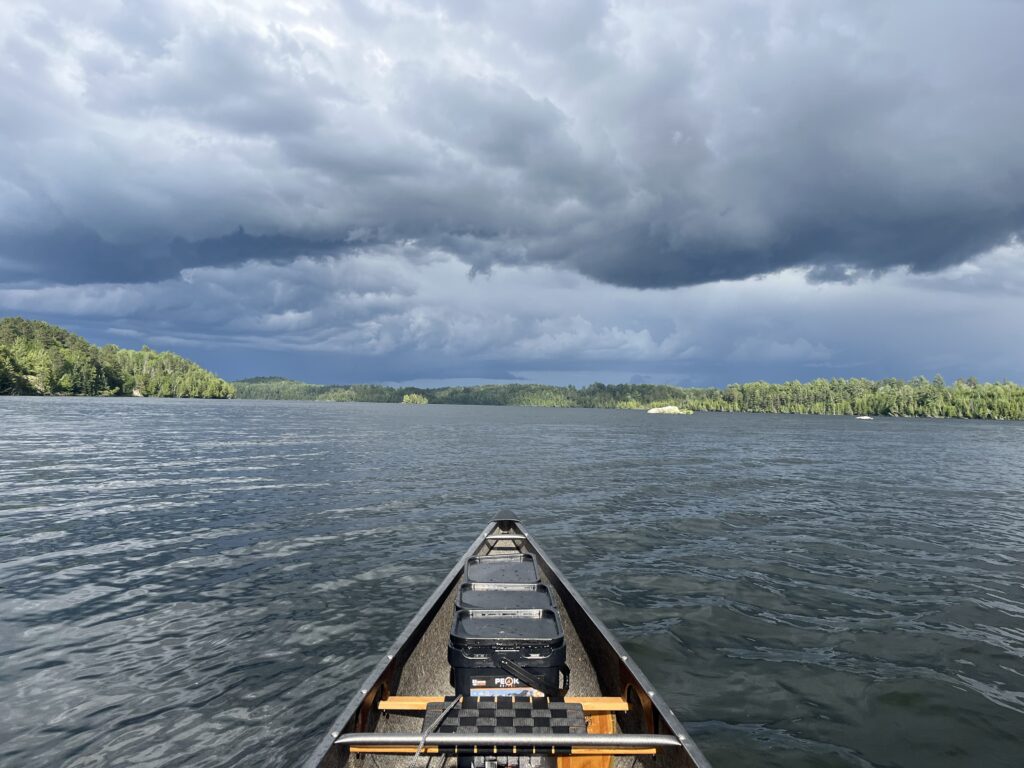
Typically, when I am talking about the quartering tailwind it involves fear or discomfort, but my relationship with it is complicated, much like my relationship with freeze-dried camp meals (delicious but not always agreeable to my physiology). On my most recent trip, which found me paddling to Kekekabic Lake from Moose Lake on a Tuesday, lake trout fishing for a couple of days, and returning on a Friday, I got to thinking about my old friend and how I should write an article about it. So here we are, some thoughts on the quartering tailwind.
WHAT IS A QUARTERING TAILWIND
First off, I’ll define it: A quartering tailwind is a wind that hits a canoe, which doubles as a sail in wind, from an oblique angle (30-45 degrees is the sweet spot). The effect is that the canoe is pushed forward, increasing speed, and off-center, threatening to turn a paddler broadside into waves, an uncomfortable combination to be sure.
I think this is a good time for a qualifying statement: Conditions can become extreme, rendering most of what I’m discussing trivial. If a 30 mph wind is blowing rollers on Lac La Croix, it doesn’t matter how well your canoe is trimmed or how talented you are as a paddler, you shouldn’t be on the water. Furthermore, extreme to one person is old hat to another, so I’ll leave judgement to the paddler for when it’s time to get off the water.
QUARTERING TAILWIND IS YOUR ENEMY
Most of the time a quartering tailwind gets a bad rap, and for good reason. When the wind is up and the waves are big, it leads to the most uncomfortable position for paddling on flatwater (sit down kayak surfers, this isn’t about you).
Headwind is much easier for a paddler to manage than tailwind, when a paddler’s actions are quickly and simply reflected in the canoe’s response to inputs. For instance, if I’m battling a headwind and the wind starts to push me to the left, if my canoe is properly trimmed (Paddler Magazine’s Adjusting Your Trim), I can simply paddle on the left or rudder on the right to counterbalance (heck, you can even throw in a bow draw on the right, or a stern draw on the left!). Furthermore, the headwind will naturally slow a canoe down so that actions are generally occurring at a slower pace. I will also say that, in my experience, humans act more intuitively when the input is coming from the front (try doing hurdles backwards).
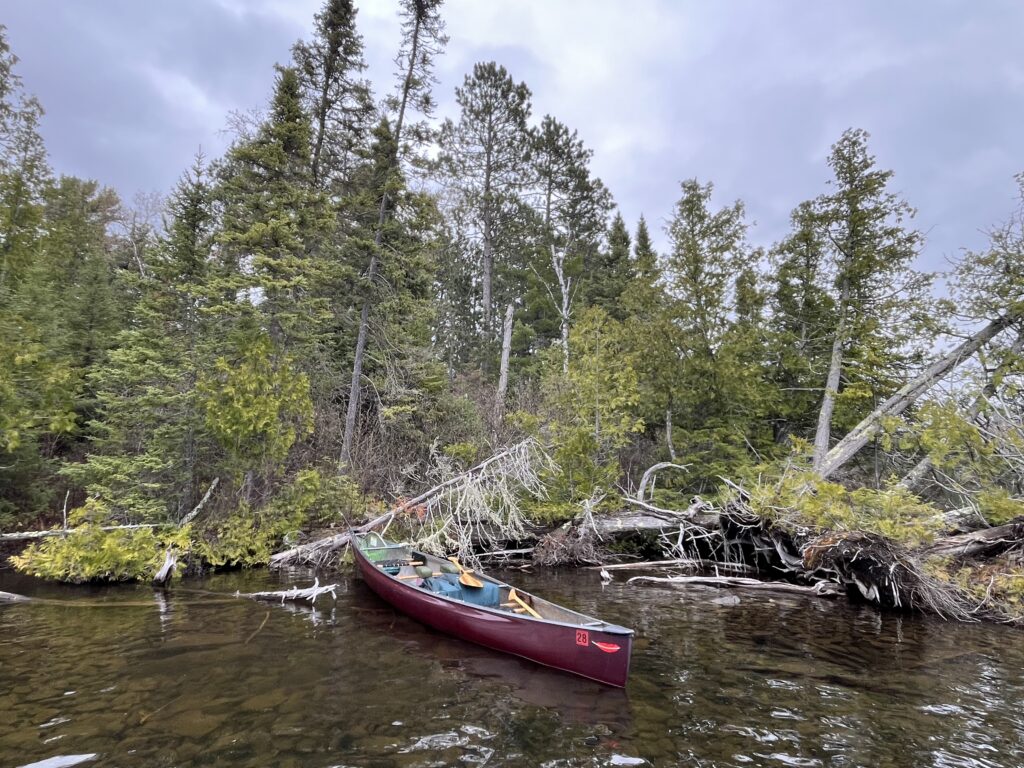
When dealing with a tailwind, the factors are not so cut and dry. The canoe’s rate of speed increases, which hurries a paddler’s decision-making process, and it is also not always clear what the best input is when being pushed from behind. These factors along with waves can be extremely difficult to manage for anyone, especially someone who is not comfortable with the feeling of a wave grabbing a boat from the side and propelling it forward at an angle. The most uncomfortable I have ever been in a canoe was coming around U.S. point on my first trip around the Hunter’s Island Loop (summarized here: https://redfeatherely.com/flooding-hunters-island/). The wind was sustaining well over ten mph, gusting twenty or more, on big water, with some of the biggest rollers I’ve paddled in. As each roller lifted the stern and ran the length of the canoe, it would create a whipping motion, creating the same force that surfers use to harness the power of a wave. When timed correctly by the stern paddler in a well-trimmed canoe, the effect is fun, if not a bit unnerving – if I had let the wave turn me sideways at any point, we surely would have been pushed over, dumped into the cauldron and blown far down the lake to be deposited on shore. This is an extreme example, but the same dynamic plays out at lower wind speeds and can feel just as precarious for a less experienced paddler. With that said, my bow paddler (who hated the experience, having no real control over the canoe in these conditions and experiencing the peak of the whipping motion) and I experienced our most efficient stretch of the entire 150-mile trip while surfing these waves down the border. This brings me to the other side of the coin.
QUARTERING TAILWIND IS YOUR FRIEND
When managed correctly, a quartering tailwind can be a paddler’s best friend. The same factors that create a balancing act, where a paddler constantly feels he is on a tightrope, can, at lower windspeeds, make for the most pleasant paddle. As I mentioned before, I was paddling this past week along the border, taking advantage of five mph winds for four days straight, where big water makes for easy miles, given the right conditions.
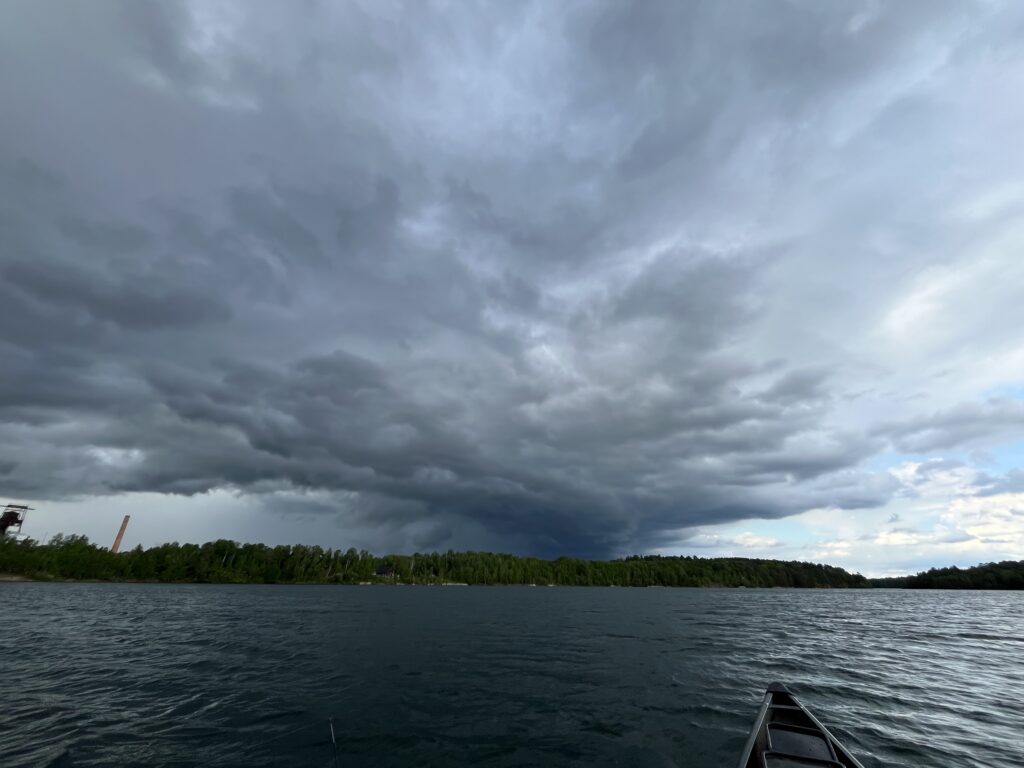
A quartering tailwind pushes on a canoe like a sail. So, as a seasoned paddler, I’ve learned that a 5 mph quartering tailwind is a great time to dial back the power of my paddle stroke and focus on maintaining an orientation where the canoe provides a surface for the wind to push me in the direction of my destination while maintaining an efficient forward momentum (I don’t want the canoe being blown sideways, as this is not efficient). This can be a huge benefit when piling up big miles, as I am able to relax and give my shoulders a rest from the constant pulling. Even on a short day-paddle, a light quartering tailwind creates the most pleasant sensation, as one lightly paddles to keep the canoe in position while gently rocking through the free ride provided by the wind.
Even at higher wind speeds, the advantages of the quartering tailwind can be harnessed, but the line between manageable and dangerous is thin, and if a paddler is cruising across big water when the line is crossed, the prospect of a long swim to shore, at the mercy of the wind’s direction, becomes real all too quickly.
AIN’T PADDLING GREAT?
One of my favorite things about paddling a canoe, especially for long distances, is that I continue to learn from the canoe – about the conditions I paddle in, how to maximize and expand the capabilities of my canoe as my experience increases – and the quartering tailwind is such a great example of this playing out. I’ve gone through so many stages of learning, unlearning, reimagining, and revising my approach to this condition and many others. I’m sure there are many opportunities for this type of experience in life, but the variability of life is expressed so remarkably in a canoe, and in a way that is hard to express (I struggled to express myself in this article!). Paddling a canoe, especially when one has taken it seriously, not to say without enjoyment or lightness, it places one into a community of likeminded people who understand something inherent in the activity that might only be palpable to others who’ve done the same, and that makes it feel pretty special.

About the Author
Tyler is the store manager at Redfeather Outdoors in Ely. He moved to Ely in 2020 and has been exploring the surrounding wilderness with his wife and kids ever since. He is an avid canoe paddler, nordic skier, and hiker. He maintained a rental fleet of over 200 canoes at a prominent canoe outfitter in Ely for 5 years before signing on to help Redfeather Outdoors open its first retail store. His knowledge of the Boundary Waters Canoe Area Wilderness and Quetico Provincial Park is extensive. When he is not in the shop at Redfeather he is either out in the woods, paddling a canoe, or coaching his son’s baseball team. Visit the store anytime and say hi to Tyler. He loves nothing more than a good canoe story and will offer anyone tips on a good daytrip or how to fix your canoe,
About Redfeather

Redfeather Outdoors has built its reputation around gear shaped by real time outdoors, with a strong emphasis on durability and performance in the conditions people actually face. Our canoes and snowshoes are handcrafted at our facility in La Crosse, Wisconsin, reinforcing a commitment to American craftsmanship and consistent quality. That hands-on approach shows up in the details, giving paddlers and winter explorers confidence as they head into the Boundary Waters and beyond. To explore our full lineup and learn more, visit https://redfeatheroutdoors.com/
That same mindset carries into our flagship store in Ely, Minnesota, a location that fits naturally with the brand’s connection to the outdoors. The Ely store serves as a hub for trip preparation and practical guidance, offering insight shaped by experience along with access to gear built for northern Minnesota conditions. It’s a place where visitors can get ready and head out with equipment they trust.